The language of sleep · Pillow guide
How Loft and Firmness Shape Down Pillow Support
A down pillow may look cloud-soft, but its job is more exacting than simply adding plushness to the bed. Loft and firmness work together to influence how your head settles, how your neck is supported, and whether the pillow feels composed or collapses beneath you. The right combination is personal—and often begins with the position in which you sleep.
Published November 16, 2026
There is an art to a well-made bed: the cool, smooth plane of a sheet; the generous fold of a duvet; the pillow, placed just so. Yet among these familiar layers, the pillow is the one asked to do the most intimate work. It meets the head and neck for hours at a time, changing shape with each turn. A pillow that feels sumptuous in the hand may not offer the right support in use, while one that appears modest can prove remarkably comfortable when its height and resistance suit the sleeper.
That distinction comes down, in part, to two qualities often discussed as though they were interchangeable: loft and firmness. Loft describes a pillow’s height—especially the height it maintains when bearing the weight of the head. Firmness describes the resistance it offers as it compresses. A high-loft pillow is not automatically firm, and a firm pillow need not be especially tall. In down pillows, where fill is mobile and yielding, these differences are particularly worth understanding.
The goal is not to find a universally “perfect” pillow. It is to find a useful balance: enough height to help keep the head and neck in a comfortable, neutral line, with enough resistance to prevent the pillow from flattening more than feels right. Sleep position offers a starting point, but shoulder width, mattress softness, body shape, and personal preference all have a say.
A closer look at loft
Imagine a pillow on an unmade bed. Its visible height is only the beginning of the story. Once you lie down, the fill compresses; how much it compresses depends on the amount and type of fill, the pillow’s construction, and the weight placed on it. For that reason, loft is most useful when considered as the pillow behaves beneath you—not simply as it stands on the bed.
A pillow with generous loft can create a higher resting surface, but its height may decrease significantly under pressure. Down is prized for its airy, pliable character: it can be gently molded and offers a soft, cushioning feel. That same yielding nature means the pillow’s apparent loft is not necessarily the loft you experience through the night. The relevant question is how much height remains once your head is settled.
Too little effective loft may leave the head dipping toward the mattress. Too much may incline it away from the mattress, creating an angle that feels strained or simply unfamiliar. These are general comfort observations, not a diagnosis: bodies differ, and a pillow cannot correct every source of neck or shoulder discomfort. Still, noticing whether your head seems tipped up, dropped down, or comfortably aligned can help narrow the field.
Firmness is about resistance, not stature
Firmness describes the pillow’s response when compressed. A softer pillow gives readily; a firmer one pushes back more noticeably. In a down pillow, that response is shaped by the fill’s volume, its distribution, the pillow’s dimensions, and the construction of the shell. Firmness is therefore not a simple synonym for support. A pillow can feel soft at first touch yet retain enough substance to provide a comfortable cushion for a particular sleeper.
Nor does a higher firmness rating mean a pillow is better for everyone. A sleeper who likes to sink into a plush surface may find a very resistant pillow awkward. Someone seeking a steadier, more substantial feel may find a softer pillow too compressible. The most useful pillow is not necessarily the one with the strongest pushback; it is the one whose response feels balanced for your body and habitual position.
Down’s character is often described in terms of loft and fill power. Fill power refers to the space occupied by a given weight of down under standardized testing conditions. It can help describe the down’s ability to loft, but it is not a direct measure of pillow firmness or a guarantee of support. A pillow’s feel depends on the full construction, including the amount of fill and how it is arranged. Treat fill power as one clue, not the whole verdict.
Why sleep position matters
Your usual sleep position changes the space a pillow needs to fill. The distance between the head and mattress is not the same for everyone, and the shoulder, in particular, affects that gap when you lie on your side. A useful first assessment is to observe your natural position, rather than choosing a pillow according to an idealized version of how you think you sleep.
Side sleepers: consider the shoulder-to-head gap
Side sleeping generally creates a larger gap between the mattress and the head than back or stomach sleeping does. A pillow with enough loft to occupy that space may feel more comfortable than one that compresses until the head sinks too low. Shoulder width and mattress firmness matter: a broad shoulder or a firmer mattress may leave a different gap than a narrower shoulder or a softer sleep surface.
In practical terms, a side sleeper can notice whether the head feels level with the rest of the body or angles down toward the mattress. A higher-loft pillow may be a useful starting point, but it should not force the head sharply upward. With down, the question is how much height the pillow retains when occupied. A pillow that begins tall but compresses dramatically may feel quite different from one that maintains a more substantial cushion.
Back sleepers: look for a measured lift
Back sleepers often need a different balance: enough loft to cushion the head and support a comfortable neck position, without pushing the chin forward. A very tall pillow may feel intrusive, while one that collapses too far may not provide the lift the sleeper prefers. Medium loft can be a reasonable place to begin, but the label alone cannot account for the shape of your shoulders, head, or mattress.
Notice how your head settles when you are relaxed, not merely how the pillow looks before you lie down. A back sleeper who enjoys a softer feel may prefer a pillow that yields gently; someone who dislikes the sensation of sinking may favour more resistance. The important thing is that loft and firmness work together rather than competing.
Stomach sleepers: be attentive to excess height
Stomach sleeping tends to place the head close to the mattress, so a lofty pillow may feel as though it lifts the head more than desired. Some stomach sleepers prefer a lower, more compressible pillow, though individual comfort varies. If you sleep partly on your stomach and partly on your side, the ideal choice may involve a compromise—or you may find that your preference changes with your position during the night.
These position-based suggestions are starting points, not rules. People move while sleeping, and comfort is subjective. If a pillow routinely feels uncomfortable or you have persistent pain, a general buying guide is not a substitute for professional advice.
The construction behind the sensation
To understand a down pillow, look beyond the words “plush” or “supportive.” Three construction details help explain why pillows with similar descriptions can feel quite different: fill power, fill amount, and shape.
- Fill power describes the lofting capacity of the down. It offers information about the fill, but not a complete measure of how firm or supportive the finished pillow will feel.
- Fill amount influences how much material is available to cushion the head and resist compression. A larger quantity of fill may contribute to a fuller feel, although construction and sleeper weight also matter.
- Shape and edge construction can affect how the pillow holds its form. A gusset, the fabric panel around the pillow’s edge, gives the pillow a more defined side profile and can help it maintain a more substantial shape.
The shell matters too. A closely woven cover helps contain the fill and contributes to the tactile experience at the surface. The pillow should be assessed as a whole object: the fill inside, the way the edges are built, the cover against the face, and the degree to which the entire form responds to pressure.
A practical example: the Manhattan Down-Filled Pillow
The Clean Bedroom Manhattan Down-Filled Pillow makes a useful case study in how several design details can coexist. It is described as a medium-firm, high-loft pillow, filled with 850 fill power large-cluster Siberian white goose down. Its two-inch gusseted edge gives the pillow a more defined profile, while a tightly woven 330-thread-count cotton cover forms the outer shell. The construction demonstrates why one feature should not be mistaken for the entire feel.
Here, high loft describes the pillow’s fuller height; medium-firm describes its stated resistance. Those labels do not contradict each other. A pillow can begin with a generous profile while still yielding under the head, and firmness describes that response rather than the pillow’s standing height alone. The gusset is another part of the picture: by adding a side panel, it helps create a more structured edge than a simple flat-seamed shape.
The listed sizes—standard, queen, and king—also affect the pillow’s proportions and quantity of fill. Size should be chosen with the bed and pillowcase in mind, but it is not a substitute for evaluating loft and firmness. A larger pillow does not automatically create a better sleeping position, and a high fill-power figure does not tell you precisely how the pillow will feel beneath your head.
For more information about this example, see The Clean Bedroom Manhattan Down-Filled Pillows. The product description notes that the down has been tested and certified by the International Down and Feather Laboratory and is sourced to the Responsible Down Standard. Those details relate to sourcing and quality assurance; they are distinct from the question of whether the pillow’s height and feel suit an individual sleeper.
How to evaluate a pillow before committing
Specifications can guide a decision, but the most revealing information comes from a deliberate comfort check. If you can try a pillow in person, give yourself time to settle into your usual sleeping position. If you are evaluating it at home, follow the return or trial terms carefully and use the pillow in a way that reflects ordinary sleep rather than a brief test on the sofa.
- Begin in your habitual position. Lie down as you normally would, allowing your shoulders and head to settle naturally.
- Check the effective height. Ask whether the pillow seems to leave your head too low, lift it too high, or provide a comfortable amount of elevation.
- Notice resistance. Does the pillow cushion the head while maintaining a feel you enjoy, or does it compress more than you want?
- Turn and resettle. A pillow should be considered in motion as well as at rest. Notice whether you need to rearrange it constantly or can settle without fuss.
- Consider your bedding and mattress. A soft mattress may allow the shoulder to sink further than a firm one, changing the space a side sleeper needs to fill.
- Reassess after a few nights. A quick impression may not reflect the experience of sleeping through a full night. Keep track of whether the pillow remains comfortable over time.
A small amount of adjustment is normal. Down can be shaped and shifted, and many sleepers gently fluff a pillow before use. But if you find yourself folding it, stacking it, or repeatedly punching it into shape to achieve basic comfort, its loft or firmness may not match your preferences.
Care, longevity, and the pillow’s changing feel
With regular use, a pillow’s feel may change as fill shifts and compresses. Follow the manufacturer’s care instructions; down-filled bedding can have specific requirements, and the shell and fill should not be treated as though they were ordinary cotton sheets. A washable pillow protector can help keep skin oils and everyday soil away from the pillow itself, reducing the need for frequent cleaning.
Fluffing can help redistribute fill and restore a fuller appearance, but it cannot make every pillow feel suitable for every sleeper. If a pillow remains flattened, uneven, or persistently uncomfortable after appropriate care, its condition may have changed enough to affect its performance. Avoid relying on a product’s original loft description as a permanent promise of how it will feel after extensive use.
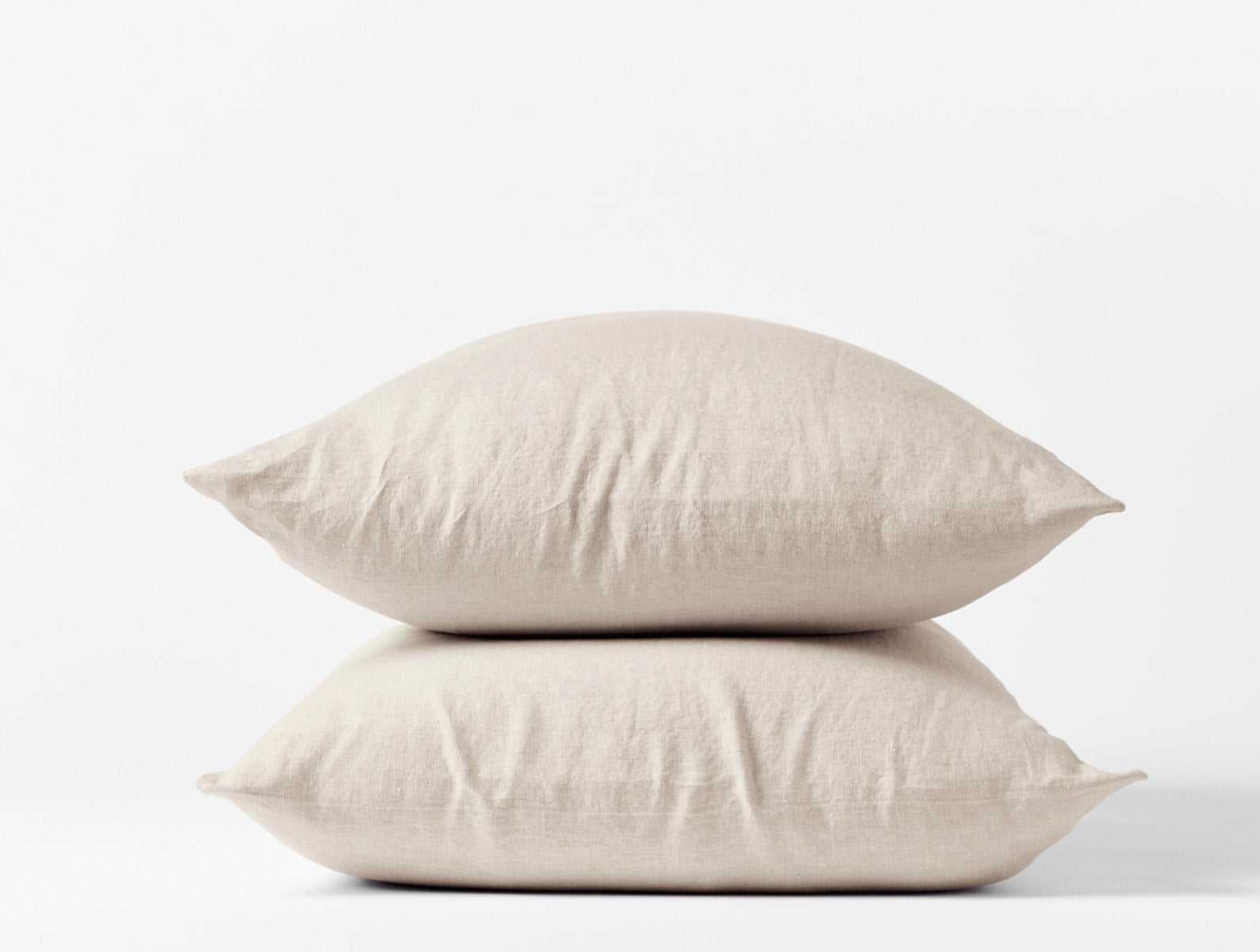
Care also includes keeping the rest of the sleep environment in view. A breathable pillowcase, such as one made from linen, changes the surface texture next to the face, but it does not alter the pillow’s internal loft or firmness. The Organic Relaxed Linen Pillowcases, for example, are described as breathable and temperature regulating, with a relaxed feel that softens over time. They may complement a bedding arrangement, but the support question still belongs to the pillow itself.
A simple framework for choosing
When comparing down pillows, resist the temptation to look for one impressive specification that will settle everything. Fill power, firmness labels, gusset dimensions, and shell details each describe a different element. Read them together, then consider your sleep position and how you like a pillow to respond.
- If you sleep mainly on your side, begin by considering the gap between your head and the mattress, including the effect of shoulder width and mattress softness.
- If you sleep mainly on your back, look for a comfortable, measured lift rather than assuming that the tallest pillow offers the most support.
- If you sleep mainly on your stomach, be alert to excess height and consider whether a more compressible feel suits you.
- If you change positions frequently, look for a balance that feels comfortable across more than one posture, rather than optimizing for a position you rarely use.
- Whatever your position, distinguish the pillow’s visible height from the height it maintains under your head.
It can be helpful to think of loft as the pillow’s architecture and firmness as its manner. One establishes the space the pillow occupies; the other describes how it responds when that space is pressed. Support is the result of their interaction with your body, your sleep position, and the mattress beneath you—not a synonym for stiffness or luxury.
The final measure is how it feels at rest
A down pillow’s appeal lies in its softness, but softness and support are not opposites. A well-chosen pillow can feel inviting while still offering a height and degree of resistance that suit the sleeper. The trick is to look past the first impression: a plush surface, a generous silhouette, or a striking fill-power number cannot tell the whole story.
Instead, consider the combination. Does the pillow preserve enough loft when occupied? Does its firmness feel reassuring or uncomfortably resistant? Does its shape hold together as you turn? Do its qualities make sense for the position in which you spend most of the night? These are more useful questions than whether a pillow is simply “soft” or “firm.”
The Manhattan Down-Filled Pillow illustrates the point with its stated high loft, medium-firm feel, gusseted edge, and high-fill-power down. Those details describe an intentional construction, but the best match remains individual. A considered choice is less about pursuing the most dramatic specification and more about finding a pillow that lets the head settle comfortably, night after night.